
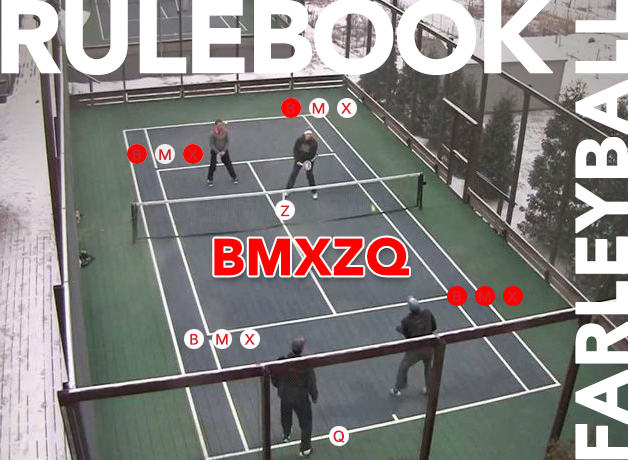
 You’ve heard about it, but you’re afraid to try it?
No, it’s not adding a little moonshine to your drinks… it’s only the latest craze to sweep the Cedar Club and soon, the world.
OK, maybe not, but if you’ve heard me (or Chad or Scott or Eric or Andy or even John-Michael) start discussing playing BMX, you may have wondered what we were talking about…. despite what Dr. Jost has to say about it. Some people just don’t see the genius when it’s right in front of them.
Flat Earthers, I say.
BMXZQ is just a fun way to add some spice into the game that we all love. I think, for the better, but you can’t knock it until you’ve tried it — you might even take a “shine” to it.
We all play FBI on league night… and some of our top rated players even bring in the M during league (I know, blasphamey!)… now, times that by a dozen and you get something approaching “Farleyball”.
So, without further ado, here’s the current RULEBOOK for the game and how you can manipulate your open paddle matches to suit your mood. Frankly, adding a well placed X into the match is better than just about any Thursday night poker party at the club.
Enjoy.
p.s. — don’t skip the sub-sections.
FARLEYBALL®
To encourage sportsmanship, showmanship, controversy and simply more fun to the game of Platform Tennis, Mike Farley, with the help of many others — (who shall remain nameless to protect the innocent) — FARLEYBALL® RULES have been developed to prevent the inventor from changing the rules mid-game.
— WARNING: Use at your own discretion —
SEC 1.0 LETTERS – all letters are optional — it’s up to the initial server to call Letter(s)
__________________________________________Art. 1.1
FBI (First ball in) — Also referred to as the “B”
Upon your first opportunity to serve in a match, you can take as many swings as it takes to get your dream serve into your opponent’s service court.
Sub 1.1.A
A “let” serve is not allowed in traditional play for this serve ONLY.
This is the Bolliger Clause for “nothing dirty”.Sub 1.1.B
FBI4 (e.g. — as in FBI-4)
You get 4 swings to get your first serve in play.This is an alteration of the FBI rule (1.1) to limit how many chances you get on your first service. If you miss all four serves, you lose the point.
NOTE: If you don’t succeed within 3 swings — hit a normal serve and stop wasting time.
Your serve just isn’t that impressive.
Sub 1.1.B.~
FBI4 (exception) However, when choosing this format, on the fourth service opportunity, a “let” serve is completely legal — play the point.As you will learn, this is a typical Farley contradiction (Farleyism) and makes game play more chaotic and fun.
__________________________________________
Art. 1.2
FMI (First miss/mulligan in) — Also referred to as the “M”
When you miss your first serve (excluding the FBI serve), you’re forced to take a “second” serve as a courtesy without losing the point.One chance only… you cannot use it as you wish (see 1.2.A)
Sub 1.2.A
FMI-# (e.g. – FMI-3 – three serves total)When playing your mulligan, you get only as many chances as pre-determined at the start of the match. However, you can use your FMI serve at any point in the match — just once in the set.
Sub 1.2.A.~
The last chance FMI serve can not be a “let” serve. If so, lose the point.
Refer to the Bolliger Clause.(1.1.A)Sub 1.2.B
No player is allowed to hoard mulligans. Use it or lose it.If you go through an entire set without needing to use an FMI serve, you do not get to pocket it as an extra for the next set. Don’t get greedy.
__________________________________________
Art. 1.3
X (i.e. – Do over)
For when you screw up… Each player in the match has one “X” to use, if they wish. The “X” nullifies the point for a single “do-over” point.
Sub 1.3.A
To qualify for an “X”, the player must have touched the ball with his paddle.Even though the previous shot was “out” (or simply sucked), calling an “X” keeps your team in the game. It’s like a poker chip. The next point will play with significantly more pressure.
Sub 1.3.B
You cannot transfer an “X” to your partner.Only the player who last touched the ball with their paddle AND has an “X” to play, is allowed to use it for their team. There is no other instance for an exception to this rule.
Sub 1.3.C
4-X’s is the limit of how many “chits” can be in play on a single game.That’s because that’s all the X’s you’ll ever get. Focus on winning THAT point. It’s a big pot and will likely turn the tide in your match!
__________________________________________
Art. 1.4
Q (Question the score)
If the server announces a score that is thought to be incorrect, any player can question the score.Players discuss the point that no one can remember and determine if the challenge is correct. If so, the serving team loses THE CURRENT service point — and should move to the other service court. Likewise, if the questioner is proven to be fraudulent, then the service team WINS the point without serving. Move to the other service court.
Sub 1.4.A
No one likes this letter* because no one seems to be able to remember the damn score.It’s also hated because it puts too much pressure on the server to actually keep their head in the game.
*everyone, except Eric McNally, who has proven to retain the service score without fail, much to the chagrin of challening opponents.
__________________________________________
Art. 1.5
Z (The Impossible shot)
The “Z” must be called prior to the start of the match. Any player that “sticks” any shot inside the center tape of the net, wins that game.A serve, a volley, an overhead, a screaming drive, even a “broken bat”… any shot that sticks is a game winner!
Sub 1.5.A
Yes, even though this would mean that you hit a ball so bad that it simply hit your own side of the net, yet somehow managed to wedge itself between the tape and the net. Regardless of game score, your side wins THAT game.— Move on.
__________________________________________
SEC 2.0
RED ZONE “Beanyball”A red flag (or square) is secured to the middle of the back screen, roughly 2’x2’ in size, half way up the screen. Players must defend the “red zone” from being hit in any point of the match. Any touch of ball to the red square is a point for the striking side.
This was introduced by TCC Legend Don “Beany” Welch. Hearing the “thwapp” of ball to target is an incredibly sinking feeling to the losing side. No extra points for demoralization.
That’s it. Clear as mud.
Recent Comments